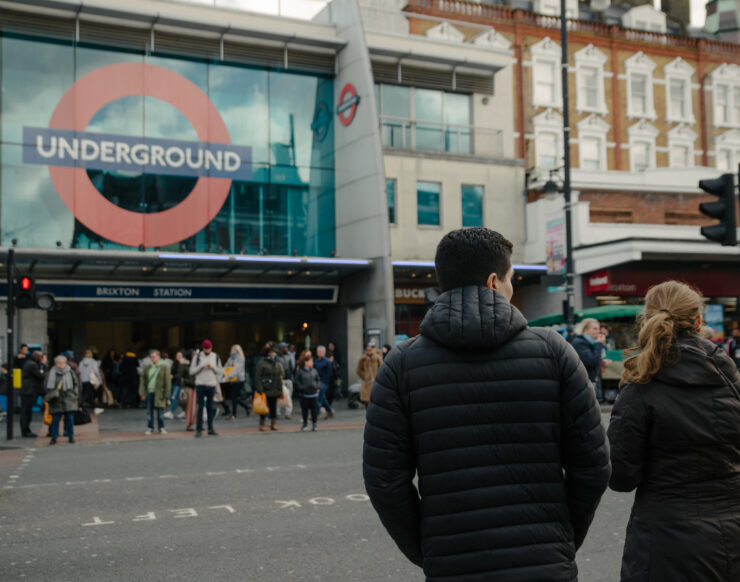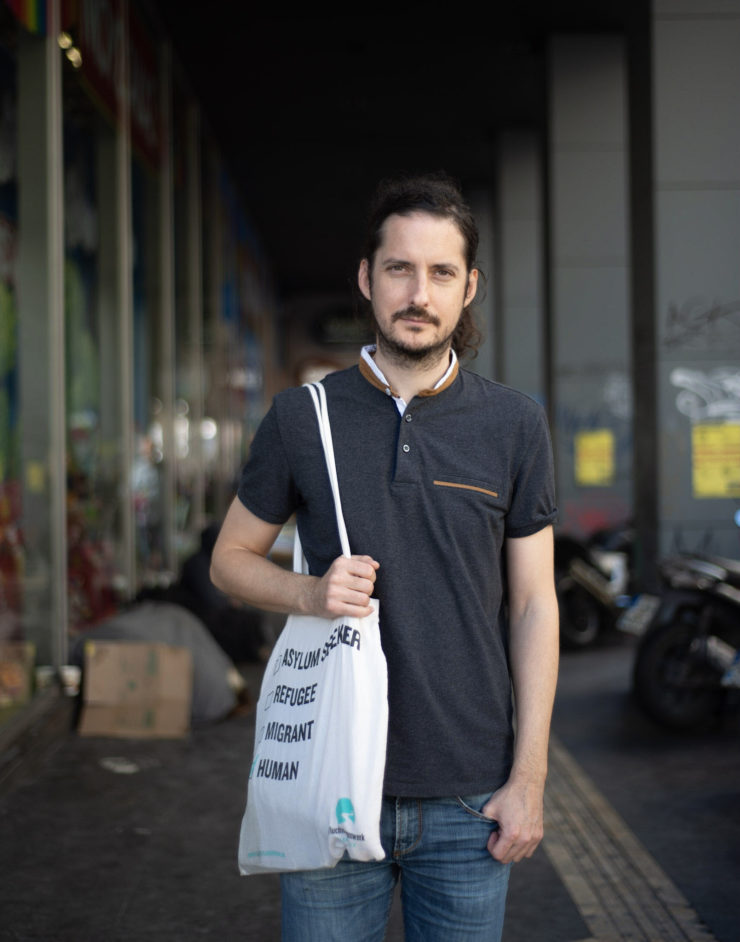


While some experiences are universal, some are particular to the historical, political and social contexts of each city. What does the digital city of refuge look like in Athens, Berlin and London?
The story of Berlin is one of apparent welcome and promise – seemingly the city closest to an ideal city of refuge. At the same time, Berlin, like other parts of Germany, experiences the rise in right-wing extremism and aggressive racism, alongside enhanced securitizing policies, which put ‘welcome’ to the test.
BERLIN: CITY OF REFUGE BUT WITH CONDITIONS?
The stories shared by many participants in Berlin reflect the ambivalence of promise and control in the city. To a large extent, these are stories of a warm and welcoming city, of solidarity and community, of safe settlement, pursuit and care. Ethics and politics of solidarity in the city are supported by its vibrant economy, including the fast-growing digital economy, and a robust welfare system. This means that, unlike Athens and London, newcomers in Berlin get access to considerable opportunities for housing, education, employment. Yet, the availability of support in Berlin has not been unconditional. Instead, it has very much hinged upon the ways in which newcomers subscribe to Germany’s national politics of systematic “integration”. The demand for “integration” appears everywhere in the life of newcomers, not only in official requirements but also in public and media discourse. To an extent at least, it represents a political and media response to rising xenophobia and racism - a displacement of responsibility for (unwelcome) change upon migrants. Media repeatedly emphasise the responsibility of newcomers to adapt to the society that received them, as if this society is stable and its values are by definition different or superior to theirs. The notion of integration, in this context, comprises both the need for newcomers to prove their economic value and independence by finding work wherever it is needed, as well as committing themselves to a mainstream understanding of German cultural and social values.
This systematic pressure to show their worthiness of public care and support weighs heavy on the lives of the newcomers we encountered. While Berlin indeed offers a secure and forward-looking perspective to numerous newcomers, its conditionality means that many newcomers and civic actors are torn between cynical and anxiety. We heard many newcomers expressing these sentiments – shaped by profound insecurities about their long-term future and by the rigid requirements of assimilation and productivity set to them. Civic actors occasionally expressed similar sentiments – being increasingly aware that access to resources is subjected to their proof of supporting the project of “integration”, not necessarily supporting those in need.
BERLIN AS A DIGITAL CITY OF REFUGE
Digital connectivity and communication encapsulate this ambivalence of the city of refuge. In Berlin, everyone is digitally connected, and networks of solidarity, community and identity are very vibrant in the city. Social media here mediate and expand the reach of refugee voices and politics, especially through sharing the many events that are organised by and for newcomers. Such digital infrastructures moreover constitute a fundamental element of state and non-state actors’ strategies for advancing refugee “integration”; often referred to as “digital integration”. In this context, the potentials of digital communication, especially in relation to employment, are recognised, well-funded and even tend to be over-celebrated: Coding schools and social enterprises that intend to contribute to the start-up digital economy of the city promote integration policies in practice and, in turn, receive considerable public and private funding. A vision of a digital future is often taken on by individuals with a disproportionate number of our young participants hoping for employment in the digital economy. At the same time, many of them are acutely conscious of the risk of surveillance and the severe repercussions this might bear for either themselves or for their loved ones abroad. A number of newcomers, therefore, confirmed that they develop certain tactics of resistance to surveillance, for example by sustaining different social media account or engaging in strategic self-censorship. Such a critical awareness is, however, by no means shared by public representatives in Germany. Even more so, national legislation actively contributes to the digital surveillance and border apparatus as it allows the state to check refugees’ social media profiles at any time. While in many ways reflecting a city of solidarity and support, Berlin’s potential to truly present refuge for people fleeing destitution, war and persecution are profoundly restricted by the logics of conditionality and control to which newcomers are subjected.